
The First 100 Users Playbook: How To Get Early SaaS Customers
You launched. The product works. The landing page looks good. But there is one problem: nobody is using it. This is the reality for most SaaS founders. The first 100 users are usually the hardest to get : but they are also the most valuable. They help you discover what your product actually needs to become.
Why your first 100 users matter
Early users are different from regular customers. They are testers, advisors, product strategists, and future advocates all at once. They reveal:
- Confusing workflows you never noticed because you built them
- Missing features that seem obvious in hindsight
- Unexpected use cases you never designed for
- Positioning problems : the gap between what you say and what users understand
Your first goal is not thousands of users. Your goal is learning.
Step 1: Stop waiting for organic growth
SEO takes months. Ads require budget you probably don't have. Brand awareness takes years. Early SaaS growth almost always comes from direct, manual effort. Your first users come from communities : founder groups, developer Slack channels, niche forums, Reddit, indie hacker spaces.
The key: do not promote immediately. Participate first. Help people. Answer questions. Become a familiar name. Then, when you mention what you're building, people already trust you.
Step 2: Talk to potential customers before selling
The best early conversations are not "Try my product."
They are: "I'm researching how companies solve this problem."
Ask:
- What is your current workflow?
- What frustrates you about existing tools?
- What would you change if you could?
- How do you currently collect feedback from your users?
These conversations do two things: they create relationships that convert into early users, and they give you product insights that no analytics dashboard can provide.
Step 3: Create a feedback engine
Your first users will tell you everything you need to know : if you make it easy. Without a structured feedback system, insights disappear into scattered emails, support messages, and random conversations you half-remember.
Create a place where users can easily say: "I found a problem," "I need this feature," or "I don't understand this." Every piece of feedback becomes product intelligence.
The simplest approach: add a lightweight feedback widget to your product from day one. A single thumbs-up/down with an optional comment captures more signal than a 20-question survey that nobody completes.
In fact, this very page uses one. .
Step 4: Turn users into product partners
Your earliest customers should feel involved in what you're building. Share what changed, why you made certain decisions, and what's coming next.
For example:
"We noticed several users struggled with onboarding. We simplified the first-time experience based on your feedback."
This creates trust. Users don't just buy products : they support products they helped shape.
Step 5: Find your product signal
Not every request matters equally. A common mistake:
- One person asks for a feature
- You build it
- Nobody uses it
Instead, prioritise by three dimensions:
- Frequency : how many users experience this problem?
- Severity : how painful is it when they do?
- Business impact : does solving it improve retention or activation?
A problem that 20% of active users hit weekly is worth more than a feature one enterprise prospect mentioned once on a call.
Step 6: Build your growth loop
The best SaaS products create a compounding cycle:
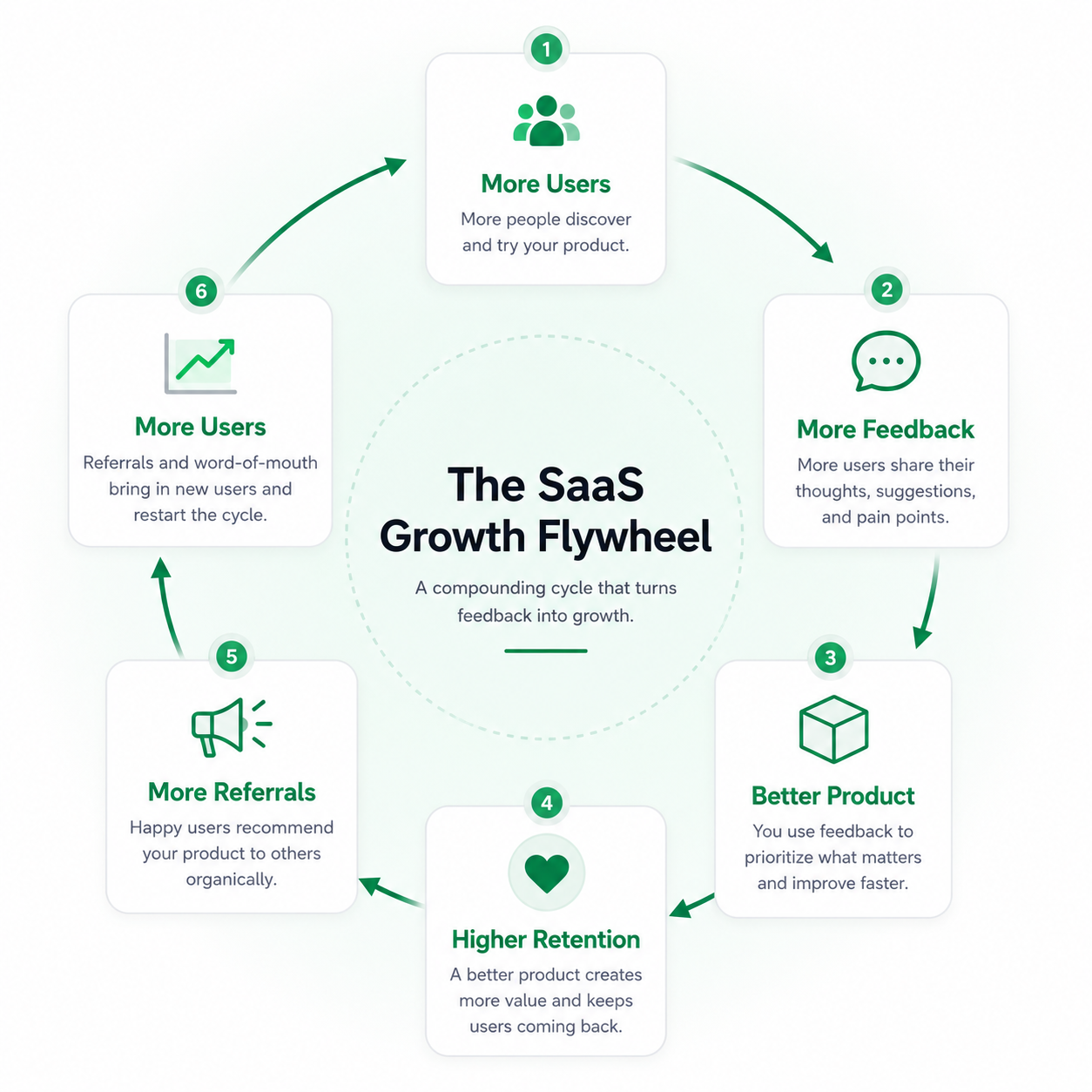
The product improves because customers improve it. Every feedback loop shortens the distance between what you built and what people actually need.
Your first 100 users checklist
Before chasing growth, make sure you have:
- ✓ Clear target customer definition
- ✓ Simple onboarding (under 2 minutes to value)
- ✓ Easy feedback collection built into the product
- ✓ Basic analytics to track activation and retention
- ✓ A fast iteration cycle (ship weekly, not quarterly)
- ✓ Customer conversations happening every week
The real goal
The first 100 users are not about revenue. They are about discovering the answer to one question:
"Why would someone choose this over everything else?"
Once you know that answer : really know it, because users told you : growth becomes much easier. Everything else (positioning, marketing, pricing) flows from that clarity.
Start collecting feedback : free forever
Add a lightweight feedback widget to your site in under 2 minutes. No credit card required.
Get started free